.svg)
The State of Delegation 2026 is a Leadership Efficiency Report for CEOs, integrators, and L&D leaders, examining how delegation habits, leadership bottlenecks, and economic pressures are reshaping the way work gets handed off. The full report is available below as accessible web text.
Prefer the designed version? Download the full report as a PDF.
Executive Summary
Delegation has entered a new era. What was once considered a personal leadership skill is now emerging as a core organizational capability—one that directly affects execution, retention, scalability, and leader wellbeing.
ITR Economics projects an extended growth phase through 2026 paired with persistent labor scarcity and ongoing inflationary pressure—conditions that make organizational clarity, capacity creation, and distributed decision-making even more critical.
Economic conditions are tighter. Hiring is more cautious. AI is accelerating workflows while simultaneously exposing the cracks in unclear expectations, weak ownership structures, and uneven leadership habits.
Our 2025 data shows that more than one-third of leaders (34.8%) identify as Time Optimists, consistently underestimating workload and contributing to systemic execution drag.
Leaders are drowning in decisions. Managers are stretched thin. Teams are experiencing execution drift—the slow erosion of alignment, speed, and accountability.
Our Organizational Efficiency Index, Bottleneck Diagnostic, Science of Letting Go series, and current research all point to the same conclusion: leaders are not struggling with delegation because they don't care or don't understand it. They are struggling because the conditions for delegation are broken. Clarity gaps, slow decision pathways, cognitive overload, and the habit of delegating tasks while still holding on to the mental load are creating avoidable drag across organizations.
The organizations that treat delegation as a system—not a personal skill—will gain a competitive advantage in 2026 and beyond.
Key Findings
- Delegation has evolved into a strategic capacity lever, not a personal preference.
- Research shows strong links between effective delegation and performance, engagement, and retention.
- Our internal data reveals persistent clarity gaps, rework cycles, and decision bottlenecks.
- AI heightens the cost of unclear delegation—vague inputs produce weak outputs.
- Delegation maturity is emerging as a measurable indicator of organizational health.
The Delegation Landscape: What's Shaping 2026
Leadership pressure is reaching a breaking point. According to DDI's Global Leadership Forecast, 40% of leaders are considering stepping out of leadership roles due to cognitive overload and unsustainable demands.
Our Organizational Efficiency Index data reflects this strain: leaders report too many decisions, too many meetings, and too little time for strategic thinking. Panel insights from the Science of Letting Go series reinforce this reality—leaders consistently underestimate the cognitive cost of holding too many decisions, and the absence of clear delegation systems compounds that burden.
The context leaders operate in today is fundamentally different. Economically, organizations face tighter margins and slower hiring. Growth now depends on creating capacity internally, through better systems and clearer structures, rather than relying on constant headcount expansion.
The workforce dynamic is shifting as well. Hybrid and distributed teams require explicit clarity around roles, expectations, and decisions. Employees want autonomy and meaningful ownership, and they stay longer in organizations that offer both. Delegation is quickly becoming a core ingredient in retention, not just a way to move work off a leader's plate.
Economic outlook data from ITR Economics reinforces these pressures: a tightening labor market with no hidden worker pool, rising wage pressure, and a prolonged growth cycle that demands efficiency "without the bloat." Leaders must scale systems, not just teams, to protect margins and execution health.
Together, these forces have moved delegation out of the realm of a "nice-to-have" leadership style and into the realm of strategic necessity.
Key Themes
- Economic pressure demands efficiency, clarity, and distributed decision-making.
- Leadership overload is slowing decisions and increasing burnout risk.
- Hybrid work raises the standard for communication and role clarity.
- Talent retention now depends on autonomy, ownership, and growth.
- Delegation is becoming an organizational capability, not an individual skill.
What Our Data Shows: The 2025 Bottleneck Types Holding Leaders Back
Our Organizational Efficiency Index and Bottleneck Diagnostic reveal strong, consistent patterns across industries. The five bottleneck types map directly to predictable breakdowns in clarity, ownership, and cognitive load.
These patterns echo findings from delegation psychology research: leaders often retain control because of a desire to avoid responsibility for potentially making the wrong choice (Steffel, 2018). As a result, they delegate tasks while holding on to the thinking—and this gap is the primary driver of rework, dependency loops, and execution drag.
The 5 Bottleneck Behavior Types
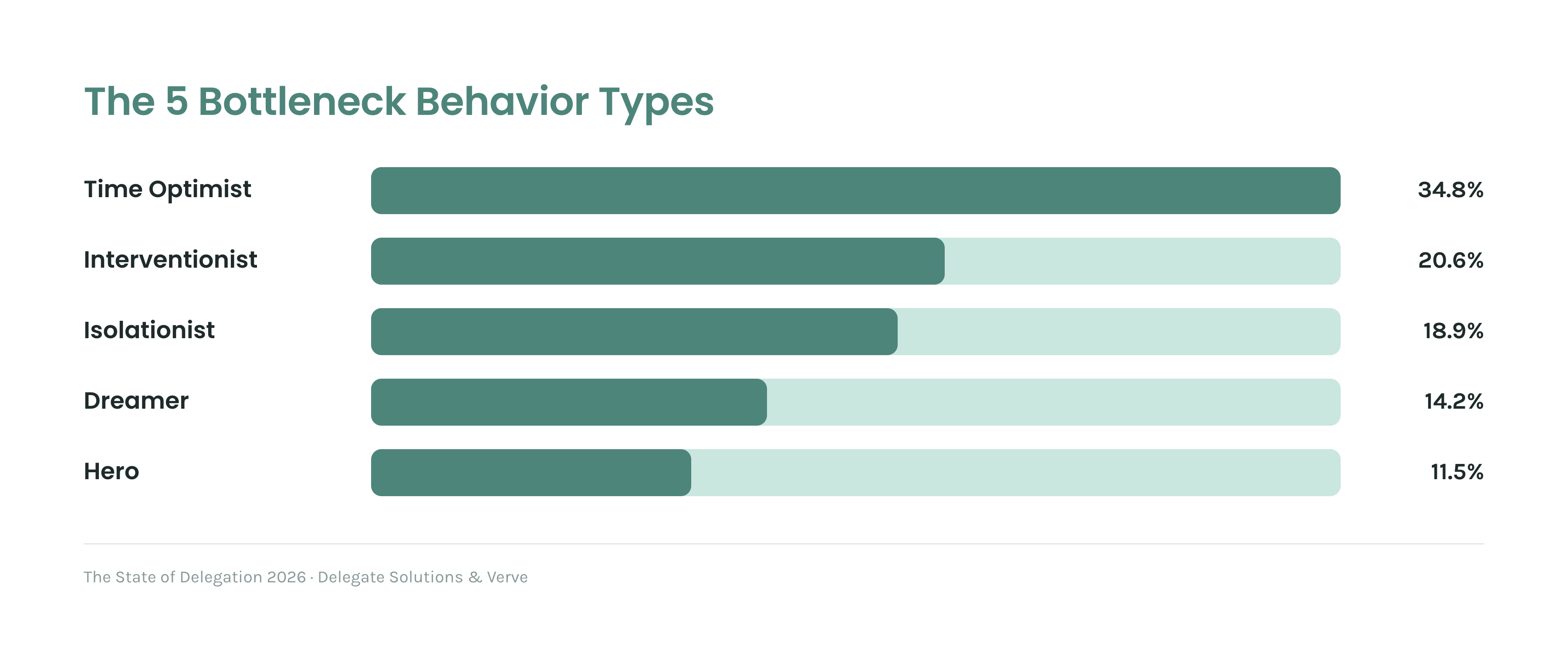
Time Optimists were the most common profile at 34.8%, making time misjudgment the single largest delegation barrier identified in the data.
- Time Optimists (34.8%) underestimate complexity and overcommit, creating constant downstream pressure.
- Interventionists (20.6%) delegate and then jump back in, inadvertently signaling a lack of trust.
- Isolationists (18.9%) hold too many decisions, slowing progress and disempowering their teams.
- Dreamers (14.2%) share big ideas without enough structure for execution.
- Heroes (11.5%) rescue their teams, which feels helpful in the moment but reinforces dependency over time.
These patterns become even more consequential in a labor-scarce environment. ITR Economics notes that wage pressure and talent shortages will continue through the decade, meaning leaders cannot afford execution drag caused by unclear ownership or over-centralized decisions.
Across all five patterns, one theme is consistent: leaders delegate tasks without truly transferring context, judgment, and decision rights. That gap fuels rework, misalignment, and burnout at all levels of the organization.
Key Findings
- The majority of bottlenecks stem from clarity and ownership issues, not capability issues.
- Leaders are holding the thinking while handing off the doing—a major driver of rework.
- Decision-making remains overly centralized at the top, slowing execution.
- Over-functioning leaders unintentionally create dependency instead of capability.
- Our data aligns with research showing clarity and decision involvement as critical performance drivers.
Why Delegation Breaks Down: Psychological & Operational Roots
Delegation failure is rarely about motivation. Most leaders know they should delegate more. The breakdown happens where psychology and operations meet.
Expert researchers from our Science of Letting Go panel discussions shared that leaders frequently avoid delegating decisions due to fear of regret—the belief that if something goes wrong, they will personally feel responsible for the outcome. This psychological barrier keeps decision-making centralized, even when teams have the skill to handle it. Leaders also described a deeply ingrained pattern of identity-based over-responsibility: believing they must be the one to solve problems because that is what has made them successful in the past. Without intervention, these fears translate directly into operational bottlenecks.
ITR's outlook underscores this challenge: with growth ahead but capacity tight, leaders who continue to absorb work instead of distributing it will face increasing strain. The economic cycle rewards organizations that build clarity and decision systems—not heroic effort.
Psychologically, leaders wrestle with fear of regret and blame if something goes wrong, identity tied to being the person who "pulls it off," and a long-standing habit of over-responsibility. They often believe they are protecting their team by absorbing work, when in reality they are depriving others of ownership and growth while burning themselves out.
Operational challenges compound these psychological patterns. Across Organizational Efficiency Index reports, leaders frequently cite unclear definitions of "done," absence of constraints, and lack of decision maps as consistent execution pain points. Research on empowering leadership reinforces that ownership clarity—not skill—is the strongest predictor of performance in hybrid environments. When leaders fail to transfer decision rights, teams hesitate, escalate, or rework. Calendar overload intensifies these issues, leaving leaders with too little time to create the clarity and context required for meaningful delegation.
Hybrid and distributed work amplify these challenges. Without shared context and explicit expectations, work stalls not because people are incapable, but because they are unsure what they own.
2025 Delegation Strain Snapshot
- 34.8% underestimate workload (Time Optimists)
- 20.6% delegate then intervene (Interventionists)
- 18.9% hold decisions too tightly (Isolationists)
- 14.2% create ideas without execution structure (Dreamers)
- 11.5% rescue instead of developing (Heroes)
Our Predictions for 2026
With more than 70% of leaders falling into Time Optimist, Interventionist, or Isolationist patterns, organizations will increasingly need systems that support delegation of thinking and decision clarity.
- Delegation becomes a strategic capacity lever. Organizations will treat delegation as part of their operating system—not a personal leadership style.
- Decision delegation goes mainstream. Leaders shift from "I'll decide, you execute" to "You own this decision; here are the guardrails."
- AI makes clarity non-negotiable. Harvard and MIT research shows AI amplifies unclear delegation—vague inputs produce weak outputs. As AI takes on more work, clarity becomes a core performance requirement.
- Time affluence becomes a leadership KPI. Identified by Dr. Ashley Whillans as a key driver of leader wellbeing, time affluence rises with effective delegation. Expect it to become a benchmark for leadership health and delegation maturity.
- Delegation becomes a retention & development strategy. High performers increasingly choose environments where they own outcomes, not just tasks. Emotional, cognitive, and operational aspects of letting go become standard in leadership development.
The Leadership Playbook for 2026
The patterns in this report point to one clear conclusion: leadership in 2026 will depend on a leader's ability to create clarity, distribute ownership, and elevate thinking across the organization. Delegation is no longer a personal habit—it's a structural performance lever.
This shift is amplified by the broader economic backdrop. According to ITR Economics, the U.S. is entering an extended growth phase through 2026, with strong corporate profits, rising capital investment, and persistent labor scarcity. In an environment where talent remains tight, margins face inflation-driven pressure, and AI adoption widens performance gaps, the leaders who thrive will be the ones who build scalable systems, strengthen decision pathways, and develop leadership capacity at every level. Margin pressure will intensify for companies that fail to invest in internal capability building now. Delegation systems are one of the most leverageable points of efficiency improvement.
Leaders don't need perfect conditions to begin. Small, deliberate moves create momentum: naming your bottleneck pattern, resetting clarity norms, transferring one meaningful decision with clear guardrails, and intentionally mapping where humans vs. AI should own work. These practical shifts compound quickly in a tightening labor market and growth cycle that rewards efficiency, autonomy, and adaptability.
Drawing from our research, ITR's most recent economic insights, and the Science of Letting Go series, the following practices will define elevated leadership in the year ahead:
1. Name and interrupt your bottleneck pattern
Awareness is the catalyst. Leaders who recognize whether they default toward Time Optimism, Interventionism, Isolation, Dreaming, or Hero habits can interrupt behaviors that create friction—critical in a cycle where efficiency gains drive competitive advantage.
2. Reset clarity norms across the team
Clear outcomes, constraints, and success criteria reduce rework and accelerate throughput. With hybrid teams and rising execution demands, clarity becomes an operational asset, not a soft skill.
3. Transfer decisions, not just tasks
Thinking delegation—the intentional transfer of judgment and decision rights—unlocks leadership capacity and strengthens succession pathways. In a labor-scarce economy, developing internal decision-makers becomes a core retention and continuity strategy.
4. Protect capacity for strategic work
ITR's outlook calls for leaders to "scale smart, not sloppy." That requires time. Research from Dr. Ashley Whillans at Harvard shows time affluence is foundational to leadership wellbeing. Reducing low-value meetings and simplifying decision pathways ensures leaders stay ahead of the cycle.
5. Map human vs. AI responsibilities
With AI becoming a defining competitive moat, leaders must be explicit: what work is automated, what remains human, and how the two interact. Harvard and MIT research confirms AI amplifies unclear delegation—making clarity a performance requirement, not an aspiration.
6. Build shared language for delegation
Teams move faster when they share the same framework for defining outcomes, scoping work, communicating expectations, and identifying bottlenecks. Shared language strengthens culture and enhances execution during growth cycles.
7. Design leadership systems, not heroic habits
ITR warns that inflation and labor constraints will put pressure on margins. Organizations that rely on heroic individual effort will feel that pressure first. Leaders should build decision maps, clarity rituals, capacity checkpoints, and delegation cadences that make the organization more resilient and scalable.
Closing Perspective
ITR's long-range outlook shows that efficiency, clarity, and leadership capacity will be differentiators during the next growth cycle—and essential buffers when conditions soften in the early 2030s.
The economic tailwinds heading into 2026 favor organizations that move with clarity, efficiency, and speed—not those that simply work harder. Delegation maturity, supported by strong systems and shared language, will become a defining signal of organizational health, talent retention, and strategic capacity.
With the U.S. economy shifting into a multi-year expansion phase, leaders who strengthen clarity, capability, and ownership now will enter the next cycle with greater resilience, adaptability, and margin protection.
Leadership is no longer about holding more. It's about elevating more.
About This Report
This research brief was developed by Delegate Solutions and Verve—two organizations dedicated to helping leaders scale with clarity, confidence, and capacity.
- Delegate Solutions works with founders, CEOs, and executive teams to strengthen execution through Executive Enablement—a strategic + implementation support model that helps leaders elevate out of day-to-day bottlenecks and operate at a higher level of strategic impact.
- Verve is a leadership development and training company focused on building modern delegation capability through the Let It Go System™, certifications, assessments, and research. Verve equips leaders and organizations with the skills, frameworks, and shared language needed to scale leadership capacity at every level.
Together, our work sits at the intersection of clarity, delegation, leadership development, and execution health—supporting individuals and organizations as they adapt to the next era of work.
Research & Data Citations
Internal Research
- Verve & Delegate Solutions. (2025). Let It Go Organizational Efficiency Index™: Aggregate Findings. Internal research dataset based on multi-industry leadership and delegation assessments.
- Verve & Delegate Solutions. (2025). Bottleneck Diagnostic Results by Type. Internal analysis of leadership bottleneck patterns across founders, executives, and managers.
- Verve. (2025). The Science of Letting Go™ Leadership Series: Panel Transcripts. Featuring research commentary from behavioral scientists and leadership experts.
Economic Outlook & Strategy
- ITR Economics. (2025). P3 Economic Outlook & Industry Trends Summary. Used for projections on growth cycles, labor scarcity, inflationary pressures, capital investment, and strategic leadership implications.
Leadership Burnout & Capacity
- Development Dimensions International (DDI). (2023). Global Leadership Forecast. Referenced for leadership strain, burnout, and role sustainability.
Time Affluence & Wellbeing
- Whillans, A., & West, C. Time Smart: How to Reclaim Your Time and Live a Happier Life. Harvard Business Review Press. Used for findings on time affluence as a predictor of wellbeing, performance, and leadership sustainability.
Delegation Psychology & Regret Aversion
- Steffel, M., Williams, E. F., & Perrmann-Graham, J. (2016). Passing the buck: Delegating choices to others to avoid responsibility and blame. Referenced for decision delegation avoidance, regret aversion, and identity-linked control behaviors.
Empowering Leadership & Hybrid Performance
- Kim, S.-S., et al. (2025). Impact of empowering leadership on adaptive performance in hybrid work environments. Frontiers in Psychology. Finds that empowering leadership significantly improves adaptive performance through increased knowledge sharing and employee agility—even in hybrid work settings.
- Handke, L., & Bartol, K. M. (2024). Empowering leadership and effective collaboration in geographically dispersed teams. Personnel Psychology, 69. Demonstrates that empowering leadership supports team performance in hybrid/distributed work contexts.
Hybrid Work, Delegation Clarity & Organizational Performance
- Höddinghaus, M., et al. (2024). Leadership in virtual work settings: what we know and what we need. International Journal of Organizational Analysis. Review of 66 empirical studies linking clarity, communication, delegation, and performance in virtual/hybrid work environments.
- Coulston, C., et al. (2025). Advancing virtual and hybrid team well-being through job design and leadership practices. Journal of Organizational Behavior. Highlights that redesigning work and delegation practices improves team well-being and performance in hybrid settings.
Talent, Retention & Ownership
- Gallup. (2025). Why Employee Engagement Matters. Ongoing research showing that organizations scoring high on engagement (clarity, ownership, autonomy) consistently outperform on retention, productivity, and overall performance.
- Gallup. (2024). Global Workplace Report. Captures long-term trends in employee engagement, engagement decline, and the cost of disengagement.
Citation Note
All internal data referenced in this report originates from proprietary research conducted by Verve and Delegate Solutions between 2024–2025. External research has been synthesized around leadership, delegation, efficiency, and execution health themes relevant to entrepreneurial, enterprise, and hybrid organizations.
The full report above is also available as a designed PDF for sharing or offline reading.