



VA vs EA vs Fractional

Most delegation doesn't fail because of the person. It fails because of the model.


An honest, side by side look at the three delegation models everyone's choosing between, plus a fourth option built to fix the flaw all three share.


U.S. Based Support

Integrated Team Model

Built for Founders & Operators

Trusted Since 2007

★★★★★

4.9 Google Rating (50+ reviews)

As Featured In

- START HERE

Why this comparison matters, and why most answers online get it wrong

Let me be honest with you, because most pages on this topic won't be. The confusion you're feeling is real. The titles overlap, providers use them interchangeably, and everyone's marketing makes their own model sound like the obvious answer. Search for a straight comparison and the most upvoted result is a Reddit thread, not because it's comprehensive, but because it's the only place that talks to you like a peer instead of pitching you.


So here's the promise for this page: the honest, peer level comparison first, and only then how we do it differently. One reframe before we start. Most articles compare job titles. That's the wrong lens. What determines whether delegation actually works isn't the title, it's the model behind it, because the model determines reliability, continuity, and total cost.


Container (1)


The three models buyers are actually choosing between

setting

Task execution at scale

Virtual Assistant

  • A remote generalist who executes defined tasks: scheduling, inbox triage, data entry, research. Built for volume and cost efficiency at a low price.
  • Best for: well defined, repeatable tasks you can document
  • Typical cost: low. Roughly $5 to $20/hr offshore, $25 to $75/hr US based
  • Key risk: you still own the thinking, the process, and the management

checklist

Full time Strategic Partner

Traditional EA

  • A full time, W-2 employee embedded in your business. Learns your priorities, manages communication, and owns outcomes rather than tasks.
  • Best for: consistent, high volume strategic needs with the budget to match
  • Typical cost: highest. BLS average near $73,680; $90K to $120K+ fully loaded
  • Key risk: still one person, plus you own hiring, onboarding, and coverage

Vector

Strategic Help, Shared Cost

Fractional EA

  • Senior level EA capability without the full time price tag. One experienced assistant's time split across a few clients, on a predictable monthly retainer.
  • Best for: real strategic support before you're ready for a full time salary
  • Typical cost: moderate. A monthly retainer, well below a loaded full time EA
  • Key risk: standard version still places a single assistant with you

Any of the three can be right. Notice the risk that keeps repeating: they're all one person.
side by side

VA vs EA vs Fractional vs Managed Team

Model Best for Strategic vs task Typical monthly cost US based? Continuity if they're out Time to productive Pricing transparency
Virtual Assistant Repeatable task overflow Mostly task Low Often offshore None work pauses Fast on simple tasks Varies
Traditional EA Consistent full time load Strategic Highest Yes None single person Slow (hire + onboard) You're the employer
Fractional EA Strategic help, part time budget Strategic Moderate Depends Usually none Moderate Often not published
Delegate Solutions Managed Team Leaders who can't afford dropped balls Strategic + execution See pricing Yes Built in backup Moderate Published

- THE PART NO ONE ADVERTISES

The continuity problem nobody talks about 


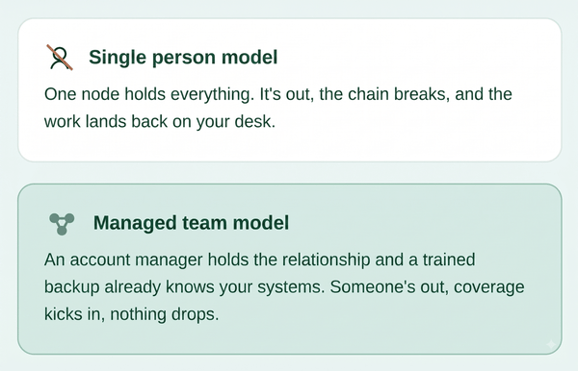
A VA, a traditional EA, and a standard fractional placement have one thing in common: they're a single person. And a single person is a single point of failure.

Play it forward. What happens when your assistant calls in sick the morning of a board meeting? Goes on a two week vacation? Gives notice and leaves? In a single person model, the answer is always the same: the work stops, the inbox backs up, the follow ups slip, and you re-absorb everything you thought you'd handed off.

Worse, all the institutional knowledge, how you like things done, who's who, where everything lives, was sitting in that one person's head. When they walk, it walks with them.

This isn't a knock on any individual assistant. It's a knock on the model. Even well known fractional providers like Boldly and BELAY are built around placing one dedicated assistant with you. A fine model, right up until that one person is unavailable. That's the moment worth designing around.

Hubspot_image_two_column

- A FOURTH OPTION

The managed delegation team

So let me earn the right to tell you how we're different. We call it Fractional Executive Enablement.

1
A dedicated three-person team

Not one person doing everything. You get two executive assistants working in tandem, one focused on strategy and one on execution, plus a dedicated account manager for oversight, alignment, and continuity. That account manager layer is what makes this a managed team rather than a lone assistant.

2
How it works together

Because the backup is pre-trained on your workflows, not cold dropped in during a crisis, coverage is seamless. Someone is always up to speed. The knowledge lives in the team and the system, not in one person's memory. So vacations, sick days, and transitions stop being emergencies.

3
Working under your brand, not ours

The team operates as an extension of your organization. Your people, your clients, your systems, no vendor badge in the way. To everyone you work with, it simply looks like your team got sharper.

How the models stack up on the things that actually break delegation


headspace
Thinking vs. doing

A VA does the doing; you keep the thinking, so you're still the bottleneck. An EA is meant to take on the thinking too, but a single person can only hold so much before coverage gaps put that strategic layer at risk. A managed team keeps the strategic thread continuous, because it doesn't depend on one person being present.

Vector
What happens when you grow

Delegation needs rarely stay flat. A solo VA or single placement hits a ceiling fast, and scaling means restarting the hire and onboard cycle. Smaller boutiques run into the same wall. A managed team model is built to flex, because the structure, not one individual, is what scales.

Vector (13)
Hidden costs beyond the rate

The sticker price is never the real price. Offshore VAs add communication overhead, time zone lag, and rework. A full time EA adds benefits, taxes, equipment, management time, and the coverage gap. And many boutiques don't publish pricing at all, so you can't compare before you talk. We publish ours.


Which model is right for you?

round-tick

Choose a VA if:

  • You have clear, documented, repeatable tasks and just need execution hands
  • Cost is your primary constraint and the work needs no judgment on your behalf
  • You have the bandwidth to direct and manage the work yourself
round-tick

Choose a traditional EA if:

  • You have a consistent, full time strategic load and the budget for a salaried hire
  • You want someone fully embedded in your culture, in house
  • You're prepared to own recruiting, onboarding, management, and coverage
round-tick

Choose a fractional EA if:

  • You need real strategic support but aren't ready for a full time salary
  • You want senior capability on a predictable retainer
  • You can accept the single placement coverage risk of the standard model

check

Choose a managed delegation team if:

  • You genuinely can't afford dropped balls when one person is out
  • You want strategic support and built in continuity, not one at the expense of the other
  • You'd rather have the structure managed for you than manage it yourself

Still weighing your options? See how our Fractional EA model  actually works.


How Delegate Solutions compares to other fractional providers

fiticon

Delegate Solutions

  • US based team: Yes
  • Published pricing: Yes
  • Dedicated account manager: Yes
  • Trained backup coverage: Yes
  • Operates under your brand: Yes
crossiconwithbg

Offshore VA Agency

  • US based team: No
  • Published pricing: Sometimes
  • Dedicated account manager: No
  • Trained backup coverage: No
  • Operates under your brand: Rarely
crossiconwithbg

Single Placement Fractional

  • US based team: Sometimes
  • Published pricing: Rarely
  • Dedicated account manager: No
  • Trained backup coverage: No
  • Operates under your brand: Sometimes
crossiconwithbg

Hidden Pricing Boutique

  • US based team: Sometimes
  • Published pricing: No
  • Dedicated account manager: Rarely
  • Trained backup coverage: Rarely
  • Operates under your brand: Sometimes

The pattern is the point. These differentiators aren't features you bolt on. They're structural, and structure is what determines whether your support holds when it matters.


Frequently Asked Questions


What is a fractional executive assistant?

A fractional executive assistant is a senior level EA whose time is split across a small number of clients, so you get strategic support without paying for a full time hire. Instead of a salary, benefits, and the overhead of an employee, you pay a monthly retainer to a provider who supplies and manages the assistant. It gives founder stage companies access to experienced executive support at a fraction of the cost of building the role in house. The one thing to check before you commit: whether you're getting a single placement or a managed team with coverage behind it.

How much does a fractional executive assistant cost?

At Delegate Solutions it runs $2,299 to $3,959 per month for 25 to 45 dedicated hours, plus a one-time $499 onboarding fee. That's a US based, dedicated team, not a single contractor billing by the hour. It also sits well below the fully loaded cost of a full time EA, which can run $90K to $120K a year once you add benefits and overhead. We publish our pricing in full so you can compare before you ever talk to us. (Link: See our published pricing -> /fractional-executive-assistant-pricing)

How are fractional executives paid?

In the fractional model, you typically don't put anyone on your payroll. You pay the provider a monthly retainer, and the provider employs, pays, and manages the assistant, including benefits, taxes, and coverage. That's part of the appeal: you get the capability without the administrative and HR burden of a W-2 hire. The structure keeps costs predictable and takes employment logistics off your desk entirely.

What is the difference between a virtual assistant and an executive assistant?

A virtual assistant is generally a task focused remote generalist who executes defined work you assign: scheduling, data entry, inbox cleanup. An executive assistant operates at a strategic level, anticipating needs, managing communication on your behalf, and owning outcomes rather than individual tasks. The simplest way to think about it: a VA clears your task list, while an EA takes work off your plate entirely, including the thinking behind it. Which you need depends on whether your problem is task volume or strategic bandwidth.

Can a virtual assistant do executive assistant work?

Sometimes, at the edges. A strong, experienced VA can take on some higher level responsibilities, and plenty of people use the titles loosely. But there's a real difference between someone who executes tasks well and someone equipped to exercise judgment, manage stakeholders, and own strategic outcomes. If you hand true executive level work to a task oriented VA, you'll usually find yourself back in the loop, still directing and still deciding. Match the model to the work you actually need done, not to the title on the listing.

Is a virtual executive assistant the same as a fractional executive assistant?

Not quite, though the terms get blurred. "Virtual executive assistant" describes where and how the person works: remotely, at an executive support level. "Fractional executive assistant" describes the commercial model: one assistant's time shared across several clients on a retainer. A fractional EA is usually virtual, but a virtual EA isn't necessarily fractional. The distinction that matters most for your decision isn't the label anyway, it's whether you're getting a single person or a managed team with continuity built in.

What happens if my assistant is out sick or on vacation?

In most models, honestly? The work pauses. In a single person setup, whether a VA, a traditional EA, or a standard fractional placement, there's no one to seamlessly step in, so your inbox backs up and you re-absorb the load until they're back. That's the continuity gap the industry doesn't like to advertise. We built Delegate Solutions specifically to close it: your team backs each other up, and if someone moves on we slot in another member who already knows your work, so a sick day, a vacation, or a transition never becomes your problem.

Ready to stop guessing and start delegating?


Here's the core insight to take with you: most delegation doesn't fail because of the person. It fails because of the model. A single point of failure will find you eventually, no matter how good the individual is.