




Fractional Chief of Staff for Founders and CEOs

A trusted strategic partner who helps you prepare important decisions, turn ideas into clear plans and move agreed priorities forward—creating more space for you to lead.

U.S. Based Support

Integrated Team Model

Built for Founders & Operators

Trusted Since 2007

★★★★★

4.9 Google Rating (50+ reviews)

As Featured In
Screenshot 2026-09-18 at 2.14.43 PM - Edited

Meet Your New Force Multiplier.

A Fractional Chief of Staff is the strategic right-hand every founder wishes they had.

They help turn your ideas into reality—driving priorities and owning the work that would otherwise pull you back into the weeds.  They work alongside you in a focused scope to clarify what matters, turn your thinking into actionable direction, and take ownership of agreed initiatives.

Your new favorite "who" that knows how to take the ball and run with it.

Signs You Need A Chief of Staff

You may have capable leaders and excellent administrative support, but still find yourself saying:

iStock Office Table Employees

  • “I need someone who can think with me—not simply take tasks from me.”
  • "Important priorities stall unless I personally drive every next step."
  • “I have specific strategic initiatives that need a dedicated owner to coordinate work across teams."
  • “I need someone who can turn my thinking into a clear plan—and move it forward.”
  • "I need to walk into important conversations with clearer context, options, and recommendations.”
  • “My EA handles my executive admin well. I need a partner who can own more strategic work.”
  • “My Integrator runs the leadership team and business. I need someone focused more closely on helping me move forward my priorities.”

What a Fractional Chief of Staff Does

A Fractional Chief of Staff works alongside you in a focused scope on strategic work that still depends on your judgment, direction, or involvement. Bloomberg recently described the role as part confidante, part concierge and part consigliere.  Depending on your needs, the work falls into these three areas:

headspace
THINK WITH ME:

Decision Support & Thought Partnership

  • Synthesize complex information into the context, options, and recommendations
  • Pressure-test ideas and assumptions before they become commitments
  • Prepare you for important meetings, conversations, and decisions
  • Bring candid perspective as you work through priorities and tradeoffs

Group (2)
MAKE IT HAPPEN:

Priority Execution & Coordination

  • Turn agreed priorities into plans with clear outcomes, owners, and next steps
  • Lead selected founder-sponsored initiatives from planning through delivery
  • Coordinate contributors and track commitments within those initiatives
  • Surface blockers and bring decisions back to you with recommendations
Frame 1707484455
CLOSE THE LOOP:

Stakeholder Updates & Follow-Through

  • Turn your decisions into clear updates for the people involved
  • Prepare board, partner, or stakeholder materials for agreed priorities
  • Gather stakeholder input and outstanding questions ahead of key conversations
  • Capture decisions and next steps so everyone involved knows what happens next

Your Chief of Staff owns agreed priority deliverables and coordinates the people needed to move them forward. Their role is to expand your capacity—to think, decide, communicate, and lead more effectively.  The scope is reviewed as priorities change. New work is prioritized against existing commitments so the engagement stays focused and achievable.
How Our Fractional Chief of Staff Service Works

Engagements begin with a six-month commitment and typically average 1–1.5 days per week. Together, we define a focused scope, establish how we’ll work together, and review outcomes every 90 days.

1
Discovery and Fit

We identify the work you need owned, review how responsibilities sit with your existing team, and confirm whether a Fractional Chief of Staff is the right solution.

We then match you with an experienced Chief of Staff from Delegate’s vetted talent community based on your priorities, business context, and working style.

2
Priorities & Working Rhythm

Your Chief of Staff builds context through conversations with you and relevant team members. Together, we agree on initial priorities, deliverables, responsibilities, and measures of success.

Every Delegate Chief of Staff works within our proven executive-leverage methodology and shared operating system, creating a consistent foundation while allowing the relationship to adapt to the founder and business.

3
Embedded Strategic Support

Your Chief of Staff becomes part of the ongoing rhythm surrounding your role.

They help prepare decisions, advance agreed initiatives, and coordinate stakeholder updates and follow-through. They stay connected throughout the week—moving priorities forward, coordinating follow-through, preparing decisions, and helping keep momentum on your most important work.

Behind the relationship, Delegate provides the methodology, tools, peer support, documentation standards, and continuity that help the engagement work as part of a larger system—not as a standalone consultant relationship.

4
Measure and Reset Every 90 Days

We review progress against three to five agreed success measures, using evidence such as milestones delivered, decisions prepared, and reduced need for founder follow-up.

Together, we reset priorities and adjust the scope to keep the engagement focused on the work that creates the most value.

image-png-Sep-22-2026-03-04-09-9787-PM

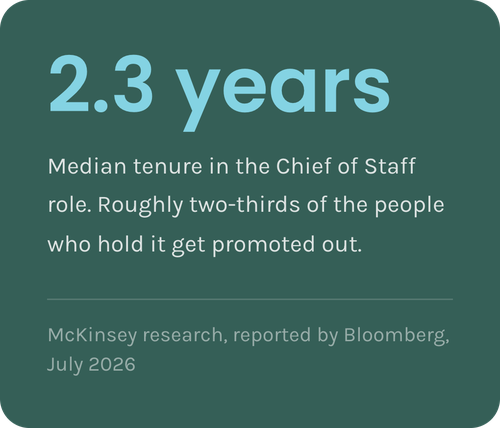
A Chief of Staff is a deeply relational role—but that relationship shouldn’t create a single point of failure. With the average Chief of Staff tenure lasting just 2.3 years, our fractional model gives you the benefit of a dedicated strategic partner, backed by a broader team, proven methodology, and continuity —so you have support behind the relationship.

Vector
One Experienced Chief of Staff

A dedicated senior partner from Delegate’s vetted talent community, matched to your needs and trained in our executive-leverage methodology.

Group 38229
A Documented System Behind Them

Consistent operating approach with shared tools and documentation with a clear scope that helps the role stay focused as your needs evolve.

Vector (15)
Oversight and Continuity

Your Account Manager checks that the engagement stays aligned with your goals and helps address scope or fit concerns. If a transition becomes necessary, documented context and a supported handover help the next person get up to speed.

Your EA continues to own executive administration. Your Chief of Staff focuses on agreed strategic priorities, decision support, and stakeholder follow-through.

Chief of Staff vs. Executive Assistant vs. Integrator or COO

These roles can work together because they solve fundamentally different problems.


Executive Assistant

Fractional Chief of Staff

COO or Integrator (EOS®)

Owns

Calendar, inbox, scheduling, travel, meeting logistics, day-to-day executive administration and support

Decision preparation, selected initiatives, and stakeholder materials and follow-through Lead and manage the leadership team, own operating results or P&L, hold leaders accountable, oversee hire/fire people decisions, resolve functional issues, and translate the company’s vision into organization-wide execution.
Reports into The executive The executive The CEO or visionary
Best when Administrative demands consume your time
Specific strategic priorities need senior ownership alongside you
The business needs executive ownership of operations


The distinction is simple:

 Your EA manages the administrative work around you.

 Your Chief of Staff strengthens the strategic work and execution surrounding you.

  Your Integrator or COO leads execution across the company.


Our Fractional Chief of Staff owns a focused scope of founder-sponsored work. They do not manage the leadership/executive team, own the company P&L, handle hire/fire decisions or take responsibility for company-wide operating results.  They are founder-focused and can complement a traditional operationally-focused Integrator seat.


iStock Office Team 1-1

How Much Does a Fractional Chief of Staff Cost?

iStock Office Team 1-1


Delegate Fractional Chief of Staff engagements start at $7,500 per month and typically average 1–1.5 days per week of work, with an initial six-month commitment.

Your investment reflects the experience required, complexity of the work, and agreed level of responsibility. Before you begin, we define the priorities, deliverables, and working rhythm that fit your engagement.

You receive a dedicated Chief of Staff backed by Delegate’s methodology, tools, and oversight. As your needs evolve, we review scope and priorities together. 

Running on EOS®?

If you run on an operating system like EOS® or Pinnacle, you likely already have an Integrator. The remaining gap is often around the Visionary: their priorities, ideas, decisions, and cross-functional work that still need senior ownership.

The pattern we see is predictable. Your Integrator is accountable for the leadership team, the operating cadence, and the numbers. Then the Visionary's world starts leaking into theirs: board prep, the idea from last week's L10 that never got an owner, turning half-formed thinking into something that can be moved forward.

None of that is Integrator work. And when the Integrator absorbs it, two things break at once. The Visionary still doesn't get proper support, and the leadership team loses the person who was supposed to be running it.

A Chief of Staff sits with the Visionary, not above the leadership team. Your Integrator keeps the company running. Your Chief of Staff gives the Visionary room to think. Your EA protects your calendar.

We run on EOS® ourselves and are a proud Pinnacle partner, so our program is built to sit alongside an operating system rather than compete with it.


Screenshot at Sep 18 11-20-07

iStock Office Desk

Not Sure What You Actually Need?

Sometimes the issue is clear: you know you need a senior partner working closely beside the executive. Other times, it’s harder to pinpoint.

You may already have an EA, an Integrator or COO, and a capable leadership team—yet too much still depends on your judgment and involvement.  Priorities stall without you. Ownership gets fuzzy. Work keeps finding its way back to your plate. And sometimes it’s not always obvious whether the answer is adding another person, a different role, or a better support structure.

IF YOU KNOW WHAT'S MISSING

Start With a Delegate Fractional Chief of Staff

You know the gap is senior strategic support focused on you—helping you prepare for decisions, move priorities forward, communicate clearly, and drive follow-through.

TALK TO US ABOUT A CHIEF OF STAFF

IF THE PROBLEM IS BROADER

Start with Executive Operations Optimization

Our EOO program looks across the entire executive office—roles, ownership, workflows, decision-making, support, accountability, and technology—to identify where the real gaps are before adding another person.

The answer may be a Fractional Chief of Staff. It may be better use of your EA, stronger ownership across the leadership team, an improved workflow, an automation solution—or simply optimizing the capacity and people and systems you already have,

→ EXPLORE EXECUTIVE OPERATIONS OPTIMIZATION

Frequently Asked Questions

What is a Fractional Chief of Staff?

A Fractional Chief of Staff provides embedded senior strategic and execution support without requiring a full-time hire. The role may include decision preparation, executive communications, strategic thought partnership, stakeholder coordination, follow-through on executive priorities, and leadership of select executive-sponsored initiatives.Fractional describes the structure of the engagement, not the seniority of the person. It's also called a part-time or virtual Chief of Staff.

How is a Chief of Staff different from an Executive Assistant?

An Executive Assistant manages administrative and logistical work around the executive. A Chief of Staff supports more strategic work, including decisions, communications, priorities, special initiatives, stakeholder coordination, and executive follow-through. Delegate considers reliable EA support an important foundation for a successful Chief of Staff relationship.

How is a Chief of Staff different from an Integrator?

An Integrator typically leads company-wide execution. They may manage the leadership team, own operating results or P&L, hold functional leaders accountable, make hire/fire decisions, and help cascade the company’s vision through the organization. A Chief of Staff works more closely around the executive’s individual effectiveness and priorities. They support the executive’s thinking, preparation, communication, follow-through, and select strategic initiatives without taking over the Integrator’s company-wide operating authority.

Can a Chief of Staff work with an existing Integrator or COO?

Yes. The roles can complement each other when the boundaries are clear. The Integrator or COO leads organizational execution. The Chief of Staff works more closely beside the executive—helping prepare decisions, move executive priorities, manage key communications, coordinate stakeholders, and lead select initiatives requiring close executive involvement.

Chief of Staff vs. fractional COO, which one do I need?

A fractional or outsourced COO leads execution across the company: operating results, functional performance, and often the P&L. A fractional Chief of Staff works beside you on your own effectiveness: decision preparation, priorities, communications, and follow-through. If execution is breaking down across the organization, you need operating leadership. If it's breaking down around you, you need a Chief of Staff.

Does a Chief of Staff manage the leadership team?

No, not in the same way an Integrator or COO does. A Chief of Staff may coordinate leaders, participate in leadership cadence, drive follow-through, and hold people accountable around priorities sponsored by the executive. Company-wide operating accountability, functional performance, and leadership-team ownership remain with the CEO, Integrator, COO, or other designated operating leader.

Does a Chief of Staff manage the executive’s calendar and inbox?

No. Routine calendar, inbox, scheduling, travel, and administrative responsibilities remain with the Executive Assistant.

Is the Chief of Staff working with me throughout the week?

Yes. Delegate’s Fractional Chief of Staff model is designed to operate within the ongoing rhythm of the executive’s work rather than functioning as a once-a-week advisory engagement. The exact cadence depends on the scope, but the Chief of Staff stays connected to priorities, decisions, stakeholders, and follow-through throughout the week.

Can an outside Chief of Staff really know our business well enough?

It's a fair question, and it's why the engagement is structured the way it is. Your Chief of Staff works inside the rhythm of your week rather than dropping in, and the first 90 days are built around learning how you think, what your priorities actually are, and how work moves through your organization. What an internal hire gets from tenure, we build deliberately and then document, so it doesn't live in one person's head. Chemistry still matters, which is why fit is reviewed rather than assumed.

When should I hire a Fractional Chief of Staff instead of full-time?

A fractional model may be appropriate when you need senior Chief of Staff capability but the scope does not yet require a permanent full-time position—or when you want to define and test the role before making a full-time hire. Your long-term answer may be to remain fractional, develop someone internally, or eventually hire a permanent Chief of Staff.

Should I start with a Chief of Staff or with Executive Operations Optimization?

Start with a Chief of Staff if you already know what's missing and you're confident the gap is senior support around you specifically. Start with Executive Operations Optimization if work keeps coming back to leadership as a whole and you can't pinpoint why, or if you've already added people and it hasn't helped. The assessment sometimes concludes that a Chief of Staff is the answer, and sometimes concludes that the structure needs to change first.

How much does a fractional Chief of Staff cost?

Most fractional Chief of Staff engagements with Delegate average 1- 1.5 days per week and engagements start at $7500 per month, scoped to the complexity of the work and the responsibility involved. That’s meaningfully less than a full-time Chief of Staff, where median total compensation runs around $222,000 before benefits, equity, and recruiting costs.

We run on EOS®. Do we need a Chief of Staff or an Integrator?

An Integrator runs the leadership team, owns the operating cadence, and is accountable for company-wide results. A Chief of Staff works beside the Visionary on decision preparation, priorities, communications, and follow-through. If nobody is running the business day to day, you need an Integrator. If your Integrator is running the business but keeps getting pulled into supporting the Visionary personally, you need a Chief of Staff.

Ready for a Strategic Partner Beside You?

Get senior support to prepare decisions, move your priorities forward, and create more space for you to lead. Let’s talk about what a Fractional Chief of Staff could make possible.  Most calls last 25–30 minutes and are led by a senior member of our team.